Last updated 2026-08-19
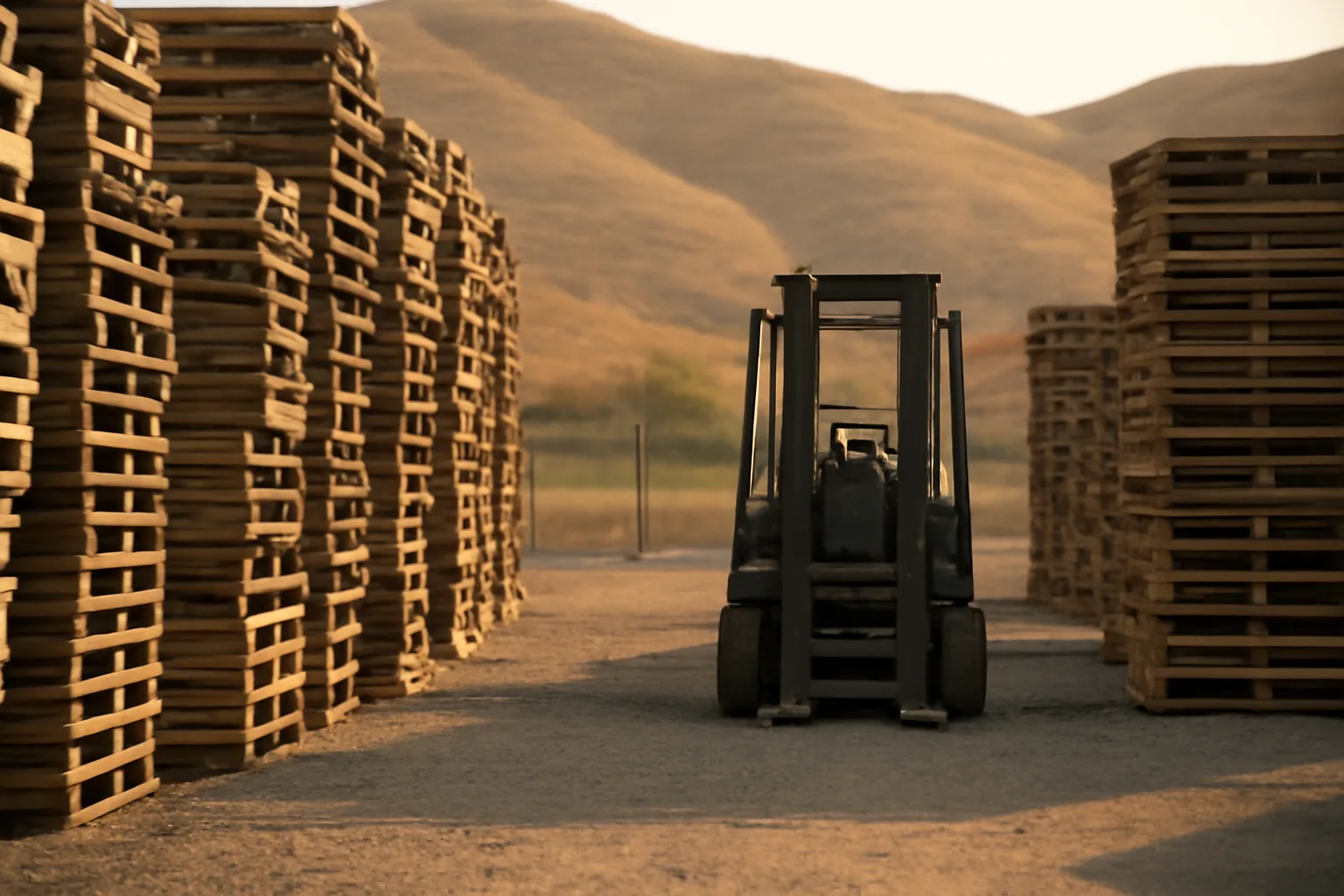
TL;DR
California does not issue a single pallet yard license. Renewal is a stack: city or county business license, CDTFA seller's permit if you sell pallets, FTB's $800 annual LLC or minimum franchise tax, and a Secretary of State Statement of Information. Fire, stormwater, solid waste, and ISPM 15 heat treatment renew only if those programs already apply. Confirm every fee and cycle with the board that collects it.
Do you need a license for a pallet yard in California?
You need licenses and permits. You do not need one statewide pallet yard license, because California never created that class. Plan on a city or county business license, a CDTFA seller's permit if you sell pallets, and entity filings if you formed an LLC or corporation. The rest depends on grinding, heat treating, employees, and outdoor storage. Confirm each item with the board that issues it.
That is the part people get wrong. Brokers talk like there is a card you hang on the fence. There is not. A pallet yard in California is ordinary business paper plus a few industrial overlays that only fire when you do certain work.
Sell repaired or recycled pallets and CDTFA treats that as a sale of tangible personal property. You register because you sell goods, not because the word pallet appears in a statute. Publication 73 is the booklet to read before you guess. [1][2]
Form an LLC or a corporation and you already owe the state's annual tax and a Statement of Information on its own cycle. That is entity paper, not yard paper. It still renews when the yard is quiet. [3][4][6]
Local land use is the real gate. Many cities treat outdoor pallet storage as a conditional industrial use. If the zoning desk says no, the seller's permit will not save you. I would call planning and the fire marshal before I signed a lease.
Paying someone to pull a California pallet license is a waste of money. Ask which form number they mean. If they cannot name the board, walk.
Junk dealer rules sit in Business and Professions Code section 21600. That definition is built around secondhand machinery and scrap metal, not wood pallets as a class. Some cities still fold used merchandise into local secondhand rules. Confirm with the city that will print your business license. [14]
What papers actually come up for renewal?
Renewal is a stack, not a single card. Most pallet yards in California renew a city business license every year, keep the CDTFA seller's permit alive by filing returns, pay FTB's annual tax, and file a Secretary of State Statement of Information on the entity cycle. Fire inspections, stormwater reports, and heat treatment audits show up only if those programs already cover the site.
Here is the working list I would keep on one sheet.
| Paper | Who | Typical cycle | Fee note |
|---|---|---|---|
| City or county business license | City or county | Usually annual | Confirm locally |
| Seller's permit | CDTFA | Stays open if you file | No permit fee. Deposit possible [1] |
| LLC or minimum franchise tax | FTB | Annual | $800 in statute [4][5] |
| Statement of Information | Secretary of State | Corps yearly, LLCs every 2 years | Confirm the current SOS fee [6] |
| IIPP | Cal/OSHA standard, your shop | Keep current | Not a card you renew [7] |
| Fire inspection | Local fire | Often annual | Local |
| Industrial stormwater | Water Boards | Annual report if covered | Confirm fee [11] |
| Solid waste facility permit | LEA / CalRecycle | Only if you are a facility | Confirm LEA [12] |
| ISPM 15 / HT program | Federal WPM path | Agency audit cycle | Confirm with your agency [9] |
City or county business license. Almost always annual. The fee is local. Confirm it on this year's city finance page, not on a blog.
Seller's permit. CDTFA does not charge a permit fee. You can still be asked for a security deposit. Close it if you stop selling or you will keep getting return notices. [1][2]
FTB annual tax. California's LLC annual tax is $800 under Revenue and Taxation Code section 17941. Corporations owe a minimum franchise tax of $800 under section 23153. [3][4][5]
Statement of Information. Domestic LLCs file with the Secretary of State every two years. Corporations file every year. Confirm the current filing fee on the SOS form before you pay anyone to do it for you. [6]
Injury prevention. Labor Code section 6401.7 says, "Every employer shall establish, implement, and maintain an effective injury prevention program." That is not a hangtag. It is a program you keep current. [7]
Then the overlays. Outdoor storage draws fire inspection. Grinding wood waste can pull in the local enforcement agency. Heat treating for export marks pulls in the federal wood packaging program. Stormwater coverage can apply to outdoor industrial yards. None of those are the pallet license. They are separate clocks.
How much does a pallet yard cost in California?
Nobody publishes a clean statewide cost to open or run a pallet yard in California. The closest hard numbers are the state filings: FTB's $800 annual tax, a free CDTFA seller's permit, and a Secretary of State statement on its cycle. Site control, rolling stock, cores, and insurance dwarf those line items. City license fees vary by city. Confirm local fees before you budget.
I will not invent a turnkey number. Inland Empire dirt does not cost what Kern County dirt costs. A paved yard with fire access is a different check than a graded lot.
What you can budget with a straight face:
State entity tax, $800 a year once you are doing business as an LLC or corporation. [4][5]
Seller's permit, no CDTFA fee, possible deposit. [1]
SOS statement, confirm the fee on the current form. [6]
City business license, often a few hundred dollars, sometimes tied to receipts. Confirm.
Insurance, workers' comp if you have employees, commercial auto, general liability. Get quotes. Skip the national average from a vendor deck.
Equipment. Used forklifts, a truck, repair saws, paint, nails. Prices move. Shop used first.
Inventory. Cores. This is usually the silent cash drain in year one.
Deposits. Lease, utilities, maybe CDTFA security.
A license package sold as if it replaces zoning is a waste. So is fancy yard software in month one. You need a forklift that runs, a place you are allowed to stack, and a way to invoice.
First-year cash is mostly rent, payroll, cores, fuel, and repairs. The state paper is real and you should not ignore it. It is not what sinks a yard.
Pricing a yard elsewhere? Look at pallet yard renewal in Arizona or pallet yard renewal in Colorado. Their tax calendars are not California's $800 clock.
How long does pallet yard take in California?
There is no official statewide clock for opening or renewing a pallet yard in California. A seller's permit can be issued quickly online. A city business license often takes days to a few weeks. Zoning or a conditional use permit, if you need one, is the long pole and can run months. Do not treat any of those as a guarantee. Confirm current processing with the office that holds your file.
Renewal is faster than a first approval when nothing about the site changed. City license renewals are usually a form and a fee. FTB tax is an annual payment. SOS statements are calendar driven. Fire re-inspections follow the local schedule.
The slow failures come from incomplete site plans, pallet stack heights the fire marshal will not accept, and people who take deliveries before planning signs off. I have no cute case study for you. That is just how these desks work.
Need a solid waste facility permit because you are processing wood waste? Different timeline. The local enforcement agency and CalRecycle process sit on top of land use. Public Resources Code section 44002 bars operating a solid waste facility without a permit. [12]
Heat treatment add-ons follow the federal wood packaging path, not the city cashier. Build that after you have a legal yard, unless export marks are the whole business.
I would not promise a customer a start date until planning and fire have both talked to you. Everything else is shorter. Nobody honest will lock a week count on a CUP.
Which state boards and local offices do you renew with?
You renew with the city or county, CDTFA, FTB, and the Secretary of State in a normal year. Add the local fire authority, the regional water board, the local enforcement agency, and your heat treatment inspection agency only if those programs already cover the yard. A permit wizard can help you list desks. It cannot file for you.
CDTFA handles sales tax. File returns on the frequency they assign. [2]
FTB handles the $800 annual tax and the business return. [3]
SOS handles the Statement of Information. [6]
EDD handles employer payroll accounts if you have staff. Confirm registration on the EDD employer pages, not through a random payroll ad.
Cal/OSHA is not a renewal desk. It is the enforcement desk for the injury prevention program and for heat illness rules under Title 8 section 3395. [7][8]
Locally you will meet the business license unit, planning, building, and the fire marshal. In some counties the CUPA will ask about diesel, propane, or shop chemicals.
Heat treat and your inspection agency under the federal wood packaging framework is another inbox. APHIS describes the ISPM 15 marking and treatment rules for wood packaging material used in international trade. [9][10]
Keep one folder with every account number. Renewal season is ugly when the city wants a seller's permit number you cannot find.
Hawaii and Idaho are not models for this stack, but the comparison helps if you run more than one yard. See pallet yard renewal in Hawaii and pallet yard renewal in Idaho.
Do pallet yards need a solid waste or recycling permit?
Some do. Many repair-only yards do not. Sort, repair, and resell pallets and you may stay outside solid waste facility permitting. Grind, chip, transfer, or store wood waste as solid waste and the local enforcement agency can require a solid waste facilities permit. Public Resources Code section 44002 says you may not operate a solid waste facility without that permit. Confirm with the LEA, not with a Facebook group.
CalRecycle writes the state rules. The LEA (usually the county) is who you actually talk to. [12]
This is where people get cute and get a notice. A pile of broken stringers you intend to grind looks like wood waste. A pile of repairable cores looks like inventory. The LEA can be interested in both if the volume and activity match a listed operation.
I would call the LEA with a plain description before I bought a grinder. The permit, if required, carries its own review and inspection cycle. That is a renewal item. It is also why some small yards stay in repair and sell the true scrap to a permitted processor.
Do not pay for a full transfer station application if you are not operating one. Do not assume repair shops are invisible if you are dumping fines and broken decks off site with no receipt.
What does heat treatment certification renewal look like?
Heat treatment marks are federal, not a California pallet license. Stamp ISPM 15 marks for export wood packaging and you work under the APHIS wood packaging framework and an accredited inspection agency. Audits and mark control follow that program. Domestic Grade A and Grade B repair with no export stamp does not, by itself, require ISPM 15. Confirm your agency's current audit cycle. Nobody here can promise an approval date.
APHIS states the core rule on its wood packaging materials page. Wood packaging material used in international trade has to meet ISPM 15 treatment and marking rules. [9]
The binding U.S. import rules live in 7 CFR 319.40. [10]
Renewal, in practice, is staying in the program. Working treatment records. Working probes. A mark you do not let walk off the property. Periodic inspection on your agency's schedule. Fail an audit and you do not renew your way out. You fix the process.
California does not issue the HT stamp. Do not ask the city for it.
If export marks are why you opened, build the chamber and the quality manual after land use and fire are nailed down. A condemned stack yard with a beautiful kiln is still a condemned stack yard.
For the paper checklist on Grade A/B repair plus HT, HeatTreatPath sells a $149 one-time kit at /start. It is a publisher kit. It is not a filing, and it does not speak for APHIS or the city.
What fire and outdoor storage rules hit pallet yards?
Outdoor pallet stacks are a fire-code problem, not a branding problem. California adopts a California Fire Code based on the International Fire Code. Chapter 3 covers general storage, including outdoor pallet storage. Stack height, pile size, aisle width, and distance to property lines are local-enforced numbers from the adopted code edition. Confirm the current edition and any local amendment with the fire marshal before you sign a lease. [13]
I put this above almost every other renewal item after the business license. A fire inspector can shut a yard down on a Tuesday. Your seller's permit will not argue.
Ask for the written standard they inspect against. Walk the yard with a tape. If the landlord's last tenant stacked to the lights, that is not a variance. That is a problem you just inherited.
Annual fire inspections are common on industrial outdoor storage. Treat the inspection as a renewal. Keep a plot plan that matches what is on the ground.
Water supply, hydrant distance, and fence access come up. So does smoking control and hot work if you run a repair booth.
This is not the place to get creative. If the marshal says cut the piles, cut the piles.
What about seller's permits, franchise tax, and the Secretary of State?
CDTFA, FTB, and SOS are the three state desks almost every formed pallet yard will touch every year or two. The seller's permit tracks sales. The $800 FTB tax tracks the privilege of doing business as an LLC or corporation. The Statement of Information keeps the entity visible on the public file. Miss FTB and penalties stack. Miss SOS and you can fall into suspended status.
CDTFA Publication 73 explains the seller's permit, including that the permit itself has no charge and that a security deposit can still be required. [1]
The CDTFA seller's permit FAQ states, "You must obtain a seller's permit if you: Are engaged in business in California and intend to sell or lease tangible personal property that would ordinarily be subject to sales tax if sold at retail." [2]
Revenue and Taxation Code section 17941 is the LLC annual tax hook. Section 23153 is the corporate minimum franchise tax hook. Both land on $800 for a normal year. Confirm whether a special first-year rule applies to your entity type and year, because the legislature has tinkered with first-year relief in the past. [4][5]
SOS wants the statement on time. Corporations, every year. LLCs, every two years. [6]
I would calendar all three the day you form the entity. Paying a bookkeeper to miss the $800 is expensive comedy.
How does zoning and a CUP affect renewal?
A conditional use permit is usually not an annual license, but it can still kill a renewal year. If your CUP carries conditions (hours, stack height, truck routing, expiry, review dates), those conditions control the yard. City business license renewal will not override a CUP. Confirm with planning whether your use is by-right or conditional before you take the first load.
This is the paper path people skip because it is slow. It is also why two yards two miles apart have different legal stacks.
If you are in unincorporated county land, the county planning department is your city. Same work, different counter.
Agricultural zoning is a common wish. Pallet storage and repair is usually commercial or industrial. Do not believe a handshake from a landowner. Get the use in writing from planning.
CUP modifications take time. Add grinding or a kiln and that can be a new condition, a new environmental look, or a new hearing. I would not order the grinder first.
Florida and Illinois are not California planning, but if you compare how other states treat the site versus the sales tax account, start with pallet yard renewal in Florida and pallet yard renewal in Illinois.
Do you need stormwater coverage for a pallet yard?
Outdoor industrial pallet yards often need Industrial General Permit coverage through the State Water Resources Control Board. The trigger is industrial activity exposed to stormwater, not the word pallet. Store pallets, cores, and scrap outside and you should ask the regional board whether your industry classification and your exposure put you in the IGP. Confirm. Do not guess from a forum post.
The industrial general permit program page and Order 2014-0057-DWQ (as amended) are the documents to read. [11]
Coverage means a Notice of Intent, a SWPPP, sampling if required, and an annual report in SMARTS. That annual report is a renewal item. Fees exist. I will not quote a fee that can move. Confirm on the Water Boards fee schedule for the year you file.
If your entire operation is under roof and you can make that true, you may have a different path. Most real yards are not fully under roof. Be honest in the paperwork. A cute filing and a dirty discharge is how you meet inspectors.
A cheap, honest SWPPP beats a glossy binder nobody follows.
What first-year operations paper should you keep?
Keep the papers that prove you are the legal operator, plus the papers a fire marshal, tax auditor, or buyer of the business will ask for. That means the lease and land-use approval, the business license, the seller's permit, FTB and SOS filings, the injury prevention program, forklift training records, purchase logs, and any HT treatment records if you mark wood. The boards still want their own filings. A pretty folder is not a permit.
Training matters. Forklift rules under Cal/OSHA. Heat illness procedures when you work outside. Title 8 section 3395 requires shade when the temperature exceeds 80 degrees Fahrenheit, plus water and planning. [8]
Purchase records matter if you ever get accused of handling stolen pallets. You do not need to act like a pawn shop unless local law says so. You do need to know who sold you the cores.
Waste receipts if you send off ground wood or metal. Insurance certificates. The fire plot plan.
I would not build a 40-tab compliance binder in month one. I would build a one-inch folder that is complete, then add the overlay programs as they apply.
Open a second site later and copy the folder structure, not the city fee. Fees do not travel. Compare the other state's stack the same way, starting with something like pallet yard renewal in Georgia.
What would I actually do if I were renewing a California yard?
I would print one calendar with every account number and the next due date. Then I would walk the yard against the last fire inspection before I paid the city. Then I would file FTB, SOS if due, and CDTFA on time. I would not hire a fixer for a license that does not exist. I would confirm every fee on the board's current page.
Order of work for a new site: planning and fire, then lease, then entity and tax accounts, then insurance and the injury prevention program, then inventory. HT only if customers pay for marks.
Order of work for a renewal year: fire and land-use conditions first, money filings second, program reports (stormwater, HT audit, LEA) third.
Skip the national myth that a pallet yard is a special state franchise. It is a yard, a sales tax account, and whatever industrial overlays you triggered.
HeatTreatPath is an independent publisher, not a law firm and not a service company. The $149 Grade A/B + HT Kit at /start is optional paper help. Confirm every fee, quota, and processing time with the board that collects it. No article can promise an approval.
Frequently asked questions
Do you need a license for pallet yard in California?
Yes, you need licenses, but not one statewide pallet yard license. Almost every operator needs a city or county business license and a CDTFA seller's permit if pallets are sold. Formed LLCs and corporations also keep FTB and SOS filings current. Fire, stormwater, solid waste, and HT marks only apply if those programs cover the site. Confirm each desk.
How much does pallet yard cost in California?
There is no official statewide open-a-yard price. Hard state figures are FTB's $800 annual LLC or minimum franchise tax and a CDTFA seller's permit with no permit fee. City licenses, rent, forklifts, cores, and insurance dominate the real budget and vary by market. Confirm every local fee. Do not buy a fake statewide license package.
How long does pallet yard take in California?
There is no statewide processing clock. Seller's permits can be fast online. City business licenses often take days to weeks. A CUP or other land-use approval, if required, can take months. Renewals are usually shorter if the site did not change. Confirm current times with planning, the city cashier, and CDTFA. No one can guarantee a date.
Is a seller's permit enough to run a pallet yard?
No. A CDTFA seller's permit covers sales of tangible personal property. It does not grant zoning, fire approval, or the right to grind wood waste. You still need the local business license and whatever land-use and fire paper the site requires. The permit can also require a security deposit even though the permit fee is zero.
Do I need a junk dealer license to buy used pallets?
Not automatically. Business and Professions Code section 21600 defines junk around secondhand machinery and scrap metal, not wood pallets as a class. Some cities still apply local secondhand or scrap rules. Ask the same office that issues your business license. Do not assume you are a junkyard, and do not assume you are invisible.
Does grinding pallets trigger a solid waste permit?
It can. Repair-only yards often stay outside solid waste facility permitting. Grinding, chipping, or transferring wood waste can pull in the local enforcement agency. Public Resources Code section 44002 bars operating a solid waste facility without a permit. Call the LEA with a plain description before you buy a grinder. Confirm, do not guess.
How often do I renew heat treatment marks?
ISPM 15 marks follow the federal wood packaging program under APHIS and your accredited inspection agency, not a California pallet card. Audit timing is set by that agency. Domestic Grade A/B repair with no export stamp does not, by itself, require ISPM 15. Confirm the current cycle with the agency that inspects you. No approval date is promised here.
Can I store pallets outside without a fire inspection?
Usually no, not if you want to stay open. The California Fire Code, Chapter 3, addresses outdoor storage including pallets. Local marshals enforce stack height, pile size, aisles, and setbacks from the adopted edition plus any local amendment. Annual inspections are common. Get the written standard before you sign a lease.
What if I operate in an unincorporated county area?
The county is your city. You still need whatever business license, land-use approval, and fire clearance that county uses. CDTFA, FTB, and SOS do not care that you are outside city limits. Planning and the fire marshal still do. Get the use in writing from county planning before the first load hits the dirt.
Do I need stormwater coverage for a pallet yard?
Outdoor industrial yards often need Industrial General Permit coverage because activity is exposed to rain, not because the product is pallets. That means an NOI, a SWPPP, and an annual SMARTS report if you are in the program. Confirm with the regional water board against Order 2014-0057-DWQ as amended. Fees change. Read this year's schedule.
What happens if I miss the $800 FTB tax?
FTB can assess the tax plus penalties and interest. For LLCs the $800 annual tax sits in Revenue and Taxation Code section 17941. For corporations the minimum franchise tax sits in section 23153. Ignoring it does not pause the city license problem. Calendar it the day you form the entity and confirm any first-year rule that applies to your year.
Can I run a pallet yard from agricultural land?
Usually not as a handshake deal. Pallet storage and repair is typically a commercial or industrial use. Agricultural zoning rarely covers an outdoor pallet business by-right. Ask planning in writing. A landowner's permission is not a permit. If you need a CUP, that review is the long pole, not the seller's permit.
Do I need a weighmaster license to buy pallets?
Only if you buy or sell by weight in a way that triggers California weighmaster rules. Many yards buy cores by the piece, not by the pound. If you run a scale and pay by weight, ask CDFA about weighmaster licensing before you print tickets. Confirm the current rule against how you actually pay suppliers.
Where do I confirm my city's fee this year?
On the city or county finance or business-license page for the current fiscal year, or at the cashier that prints the license. Do not use last year's blog number. Pair that local fee with FTB's $800 tax and CDTFA's no-fee permit. If a consultant will not show you the live board page, do not pay them.
Sources
- CDTFA Publication 73, Your California Seller's Permit: California seller's permit rules for sellers of tangible personal property, including that the permit itself has no charge and a security deposit may be required
- CDTFA, Do You Need a Seller's Permit? FAQ: A seller's permit is required if you are engaged in business in California and intend to sell or lease tangible personal property ordinarily subject to sales tax
- California Franchise Tax Board, Limited Liability Company: California LLCs doing business in the state have FTB filing and annual tax obligations
- California Revenue and Taxation Code section 17941: An LLC doing business in California pays an annual tax equal to the applicable amount in RTC 23153, which is $800
- California Revenue and Taxation Code section 23153: The corporate minimum franchise tax applicable amount is $800
- California Secretary of State, Statements of Information: Corporations file a Statement of Information annually and domestic LLCs file every two years
- California Labor Code section 6401.7: Every employer shall establish, implement, and maintain an effective injury prevention program
- Cal/OSHA Title 8 CCR section 3395, Heat Illness Prevention: Shade shall be present when the temperature exceeds 80 degrees Fahrenheit for outdoor workplaces covered by the standard
- 7 CFR Part 319 Subpart I, wood packaging material (WPM): U.S. import rules for regulated wood packaging material live in 7 CFR 319.40
- State Water Resources Control Board, Industrial Storm Water Program (Order 2014-0057-DWQ): California industrial facilities with stormwater exposure may need Industrial General Permit coverage, SWPPP, and annual reporting
- California Public Resources Code section 44002: A person shall not operate a solid waste facility without a solid waste facilities permit
- 2022 California Fire Code, Chapter 3 General Requirements: California Fire Code Chapter 3 covers general storage requirements, including outdoor pallet storage enforced by the local fire authority
- California Business and Professions Code section 21600: Junk is defined around secondhand machinery and ferrous and nonferrous scrap metals, not wood pallets as a class