Last updated 2026-08-18
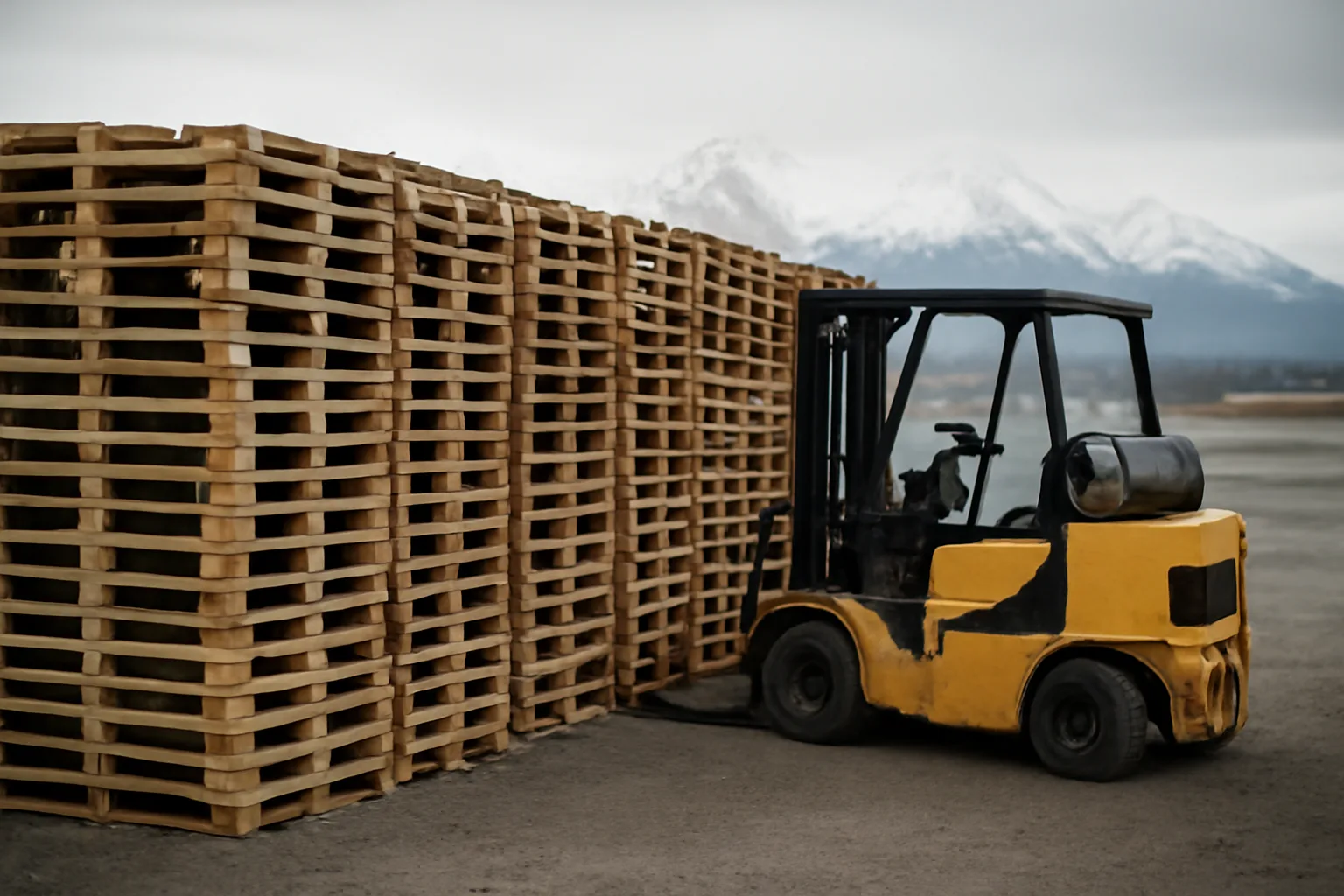
TL;DR
Starting a pallet yard in Alaska means registering your business with the state, complying with ISPM-15 heat-treatment rules if you export pallets internationally, and clearing local zoning. No single state-level "pallet yard license" exists. A bare-bones domestic resale yard runs $5,000 to $20,000 in early costs. A full heat-treatment operation runs $40,000 or more. Most paperwork clears in two to eight weeks.
What is a pallet yard in Alaska, and how does the business actually work?
A pallet yard buys, sorts, repairs, and resells wood pallets. Some yards live on used-pallet arbitrage: buy broken ones cheap from grocery or hardware distribution centers, fix them with a pallet nailer, and sell Grade A or B pallets back to shippers. Others run heat-treatment operations and stamp pallets for international export under ISPM-15. A few do both.
Alaska changes the math. Most freight into the state arrives by ship or air, and outbound pallets often dead-end because return shipping costs too much. Pallet scarcity is real in some regions, which is genuinely good news for a startup yard. It also means your suppliers (companies offloading used pallets) cluster in Anchorage, Fairbanks, or Juneau, so where you set up matters a lot.
Decide which version of the business you are running before you sign a lease or buy a forklift. Heat-treatment for export needs USDA-accredited equipment and audits. A local repair-and-resell yard does not. The paper path splits right there.
Do you need a license for a pallet yard in Alaska?
Alaska has no standalone "pallet yard license." What you actually need is a stack of general business registrations, plus a federal compliance program if you heat-treat for export.
Here is the stack.
Alaska business license. Every person or entity doing business in Alaska must hold a current Alaska Business License from the Alaska Department of Commerce, Community, and Economic Development (DCCED). The fee is $50 per year for most applicants under the current schedule; confirm before you file [1]. You apply online through the state's business license portal.
Entity formation. Operating as an LLC or corporation instead of a sole proprietor means filing Articles of Organization or Incorporation with the Alaska Division of Corporations, Business, and Professional Licensing. Filing fees vary by entity type; the LLC filing fee has been $250, so confirm with the division [2].
Federal Employer Identification Number (EIN). Hire employees or operate as anything other than a sole proprietor and you need an EIN from the IRS. It is free and instant online [3].
Local business license or permit. The Municipality of Anchorage, Fairbanks North Star Borough, and other local governments may want their own business registration or home occupation permit. Ask your local government directly.
Zoning clearance. Pallet yards are noisy, forklift-heavy operations. Most municipalities zone them industrial or light industrial. Confirm your site is zoned right before you sign anything.
ISPM-15 / USDA heat-treatment accreditation (if you export). This is the big one for yards that treat pallets for international shipment. The United States is a signatory to ISPM-15, the international phytosanitary standard for wood packaging. Heat-treat pallets and stamp them with the IPPC mark, and your facility must be accredited through a USDA Animal and Plant Health Inspection Service (APHIS) recognized program provider [4]. The American Lumber Standard Committee (ALSC) runs one of the primary accreditation programs in the U.S. [5]. Accreditation means an equipment inspection, temperature monitoring records, and ongoing audits.
You skip ISPM-15 entirely if you only sell pallets domestically. Many small Alaska yards never touch it. But if you want to sell to freight forwarders moving goods internationally, the stamp is non-negotiable.
See the full breakdown in our pallet yard license in Alaska guide.
How much does starting a pallet yard in Alaska cost?
Cost swings hard depending on whether you start with a truck and a used pallet nailer in a rented gravel lot, or build a full heat-treatment facility. Here is an honest breakdown by category.
| Cost Item | Low-End Estimate | High-End Estimate | Notes |
|---|---|---|---|
| Alaska Business License (annual) | $50 | $50 | Confirm with DCCED [1] |
| LLC filing fee | $250 | $250 | Confirm with DCCED [2] |
| Local permits and zoning | $100 | $500 | Varies by municipality |
| Site lease (gravel yard, first month + deposit) | $1,500 | $6,000 | Anchorage industrial rates |
| Used pallet nailer / pneumatic tools | $400 | $2,000 | New vs. used |
| Forklift (used) | $8,000 | $25,000 | Propane or electric; new is much higher |
| Heat-treatment kiln (if applicable) | $15,000 | $60,000 | Prefab vs. custom build |
| ALSC accreditation program fee | $500 | $2,000 | Varies by program provider [5] |
| Insurance (general liability, first year) | $1,200 | $4,000 | See section below |
| Lumber and fasteners for repairs (first month) | $300 | $1,000 | Market-dependent |
A bare-bones domestic resale yard with rented space, a used nailer, and zero heat-treatment capability can technically open under $5,000 in licensing and tooling. Add a forklift and one month of lease and you are closer to $15,000 to $20,000 all-in before revenue. A full heat-treatment operation with a kiln and accreditation is a $30,000 to $80,000-plus startup, depending on site conditions.
Alaska stacks a premium on nearly everything. Equipment barged from Seattle through carriers like Northland or TOTE can add 15 to 30 percent to the price of a forklift or kiln compared to buying the same unit in the lower 48. Budget for it.
Nobody has clean public data on average Alaska pallet yard startup costs. The ranges above come from state fee schedules, equipment market surveys, and industrial lease comps, not a single tidy study.
How long does starting a pallet yard in Alaska take?
The paperwork moves fast. Alaska Business License applications process in roughly five to ten business days online, and the state's guidance says most are issued within ten days [1]. LLC formation through the Division of Corporations is similar, often two to five business days for online filings [2].
Here is what drags.
Zoning and site approval. If your site needs a conditional use permit or a variance, municipality timelines run four to twelve weeks depending on the planning department's schedule and whether a public hearing is required.
ISPM-15 accreditation. The ALSC process means submitting an application, having your heat-treatment equipment inspected by a third-party auditor, and proving your temperature monitoring works. Plan on six to twelve weeks from application to IPPC stamp authority, and that assumes no back-and-forth on equipment compliance [5].
Equipment procurement and shipping. Barging a forklift or kiln to Alaska takes two to four weeks from the Pacific Northwest. Build that into your timeline unless you buy equipment already in state.
Realistic timeline for a domestic resale yard with no heat treatment: four to six weeks from first filing to first pallet sale, assuming zoning is clean. A heat-treatment operation: three to five months minimum.
What entity structure should you use for an Alaska pallet yard?
Most small pallet yards open as single-member LLCs. The reason is plain: personal liability protection without the paperwork weight of a corporation. If a forklift accident damages a customer's truck or hurts a worker, you do not want that claim reaching your house and savings.
Sole proprietorships are cheaper to start (no LLC filing fee) but give you zero liability separation. A corporation makes sense if you plan to bring in investors or run with multiple equal partners, but it adds state reporting and cost.
Alaska LLCs file a biennial report to stay active (confirm the current fee and schedule with the Division of Corporations) [2]. Miss it and the state administratively dissolves your entity, which is a real problem if you hold contracts in the company's name.
Get an EIN from the IRS even if you start solo. Banks require it for a business checking account, and you need that account to keep personal and business money apart. That separation also matters if you ever face an audit [3].
What insurance does an Alaska pallet yard actually need?
Insurance stops being optional the moment you have employees or a lease. Landlords almost always want a certificate of general liability coverage before they hand over keys.
General liability. A $1 million per-occurrence / $2 million aggregate policy is the standard floor for a pallet yard. Premiums track revenue and payroll; a small startup might pay $1,200 to $2,500 a year. Get quotes from a commercial lines broker who knows light industrial operations.
Workers' compensation. Alaska requires employers to carry workers' compensation coverage for employees, with very limited exceptions [6]. Forklifts, nailers, and heavy stacking mean claim frequency is real. Do not skip this.
Commercial auto. Run a truck to pick up or deliver pallets and your personal auto policy will not cover it. Commercial auto is a separate policy.
Property insurance. Own a kiln or serious equipment, insure it. Pallet yards are fire risks, a heat-treatment kiln raises that profile, and some insurers exclude poorly maintained equipment.
What are the ISPM-15 heat-treatment rules that apply in Alaska?
ISPM-15 is International Standards for Phytosanitary Measures No. 15, issued by the International Plant Protection Convention (IPPC). It governs wood packaging material moving in international trade to stop the spread of invasive insects like the Asian longhorned beetle and emerald ash borer.
The IPPC standard requires the wood to reach a core temperature of 56°C for a minimum of 30 continuous minutes [4]. That is the target your kiln has to hit and document.
In the U.S., APHIS runs compliance. Accreditation goes through approved program providers, and the ALSC Wood Packaging Material (WPM) program is the largest [5]. Accredited companies can apply the IPPC mark (the wheat-stalk symbol with the treatment code, country code, and producer number) to treated pallets.
An Alaska-specific note: pallets moving between Alaska and the contiguous U.S. count as domestic trade and need no ISPM-15 treatment. Pallets moving to Japan, Canada, the EU, or most other trading partners do. Given Alaska's Pacific Rim position, many operators here end up handling international freight customers, so understanding the requirement early saves headaches.
If you plan to offer heat-treatment services, HeatTreatPath's Grade A/B + HT Kit covers the paper path for setting up your documentation system, including the temperature log formats and lot-tracking records auditors actually check.
How do you find pallet sources and customers in Alaska?
Your suppliers are businesses that generate pallet waste: grocery distribution centers, building supply stores, breweries, and manufacturers. In Anchorage, target the Midtown and Port MacKenzie industrial corridors. In Fairbanks, work the freight consolidators near the airport and rail depot. Cold-call receiving managers, not purchasing managers. The person who decides what happens to used pallets is usually the warehouse supervisor.
Your customers are businesses that ship or receive goods on pallets: lumber dealers, food distributors, freight forwarders. Military logistics contracts are worth chasing if you are near Fort Wainwright or JBER, though getting on the procurement list takes time.
Pricing on used Grade A pallets moves with the market. Standard 48x40 GMA pallets have sold in the $6 to $15 range in lower-48 markets, with big regional swings. Alaska's supply constraints can push prices higher, but so can the cost to ship new pallets in. Nobody publishes Alaska-specific pallet price indices. Talk to local freight forwarders before you set your price sheet.
What equipment does a small Alaska pallet yard actually need to open?
Here is the minimum viable kit for a domestic resale yard.
Forklift. You cannot run a pallet yard by hand. A used 5,000 lb. propane or LP forklift is the workhorse. Propane fueling is widely available in Alaska. Electric forklifts are cleaner, but charging in cold conditions cuts range hard.
Pallet nailer. A pneumatic pallet nailer speeds up repair by roughly five times over a hammer. Used Bostitch or Duo-Fast nailers run $400 to $1,000.
Air compressor. It has to keep up with the nailer. A 30-gallon 5-HP unit is the practical floor for production work.
Sorting and stacking space. You need a flat, paved or gravel surface. Soft ground plus a loaded forklift equals tipped stacks and accidents.
Add heat-treatment and you need an enclosed kiln (wood or insulated metal construction), a forced-air heating system, USDA-approved temperature monitoring probes with data loggers, and fire suppression. The kiln build or purchase is the single biggest capital line in the operation.
For how equipment needs shift by state market, see our guide on how to start a pallet yard in California, which has one of the most developed pallet resale markets in the country.
How does Alaska's climate affect pallet yard operations?
Cold matters. Wood turns brittle in sub-zero temperatures, so pallet repair quality drops when you are nailing in January in Fairbanks. Heat your repair area or you will snap boards and strip fasteners all day.
Ground freeze wrecks site drainage. A gravel lot that drains fine in August can turn into a standing-water pond during May breakup. Ask your landlord about drainage before you commit, and look at photos of the lot in spring.
Forklift fluid and battery performance both drop in extreme cold. Propane forklifts generally handle Alaska winters better than electric ones, which is why most interior yards run propane.
Fire risk from heat-treatment kilns climbs in dry interior winters. Make sure your kiln placement meets local fire codes and that you keep suppression equipment on site. The Fairbanks North Star Borough fire code follows the International Fire Code with local amendments; check with the borough fire marshal before you build [7].
Summer brings long daylight, which is an operational gift. A yard running 6 AM to 9 PM in June moves a lot of pallets. Plan peak inventory and staffing around summer if your customer base ships seasonally.
What taxes does an Alaska pallet yard pay?
Alaska has no state income tax and no statewide sales tax, which is genuinely unusual and good for small businesses [8]. That does not mean you pay nothing.
Federal income tax applies to business profit. The rate depends on your entity structure and total income. A single-member LLC is taxed as a pass-through: net income flows to your personal return and hits self-employment tax (15.3% on the first $168,600 of net self-employment income for 2024; confirm current thresholds with the IRS) [9].
Local sales taxes are a patchwork. The Municipality of Anchorage has none. Juneau charges 5%. Fairbanks city has no sales tax, and the borough does not either. Confirm with your specific municipality.
Alaska requires state unemployment insurance (UI) contributions through the Alaska Department of Labor if you have employees, filed on the department's schedule [10]. New-employer UI rates are set annually, so confirm the current rate with the department before you budget.
Keep receipts for lumber, nails, forklift fuel, and equipment repairs. Those are all deductible business expenses. A CPA who knows Alaska small business earns the fee in year one.
Where can you get more detailed guidance for adjacent states?
Researching multiple markets, or curious how Alaska stacks up? The state-guide series covers the full pallet licensing picture state by state. A few useful comparisons.
How to start a pallet yard in Alabama shows a lower-cost entry market with a well-established pallet resale network.
How to start a pallet yard in Arizona is relevant if you also serve Southwest freight corridors.
How to start a pallet yard in Colorado covers a mountain-state market with logistics constraints that rhyme with Alaska's.
For the deeper licensing paper path in Alaska, the pallet yard license in Alaska guide goes further on the ISPM-15 accreditation application steps and what auditors actually check.
HeatTreatPath's documentation kit for Grade A/B and heat-treated pallets (at /start) is worth a look if you are building your lot-tracking and temperature log system from scratch. It does not replace state registration or USDA accreditation, but it hands you the paper formats accreditation auditors expect to see.
Frequently asked questions
Do you need a license for a pallet yard in Alaska?
Yes, but not a pallet-specific one. Every Alaska business needs an Alaska Business License from DCCED, currently $50 per year (confirm current fee). Form an LLC and you file separately with the Division of Corporations. Heat-treat pallets for international export and you need USDA APHIS-recognized accreditation through a program like the ALSC Wood Packaging Material program. Local zoning approval is also required before you operate.
How much does it cost to start a pallet yard in Alaska?
A bare domestic resale yard can open for $5,000 to $20,000 in early costs, covering licensing, a used nailer, basic tools, and first month's site lease. Add a used forklift and costs reach $15,000 to $30,000. A full heat-treatment operation with a kiln and ISPM-15 accreditation runs $40,000 to $100,000 or more depending on kiln construction and site buildout. Equipment shipping to Alaska adds a meaningful premium.
How long does it take to start a pallet yard in Alaska?
State business registration takes five to ten business days. Local zoning can take four to twelve weeks if a hearing is required. ISPM-15 heat-treatment accreditation adds six to twelve weeks. Equipment shipping from the lower 48 adds two to four weeks. A domestic-only resale yard can realistically open in four to six weeks if zoning is clean. A heat-treatment operation takes three to five months minimum.
Does Alaska require a special environmental permit for a pallet yard?
No state-specific pallet yard environmental permit exists, but you may need stormwater runoff controls if your site disturbs more than one acre, which triggers an Alaska-issued permit through the Alaska Department of Environmental Conservation. Wood waste disposal also has rules, and burning treated pallets is prohibited. Check with DEC and your local municipality before assuming you are exempt.
Can you run a pallet yard from residential property in Alaska?
Almost certainly not. Pallet yards are noisy industrial operations with forklifts and power nailers. Residential and most commercial zones prohibit this use. You need an industrial or light-industrial site. Operating from residential property risks a zoning violation, lease termination, and neighbor complaints that can force closure. Always confirm zoning before signing a lease.
What is ISPM-15 and does it apply to pallet yards in Alaska?
ISPM-15 is the international phytosanitary standard requiring wood packaging material in international trade to be heat-treated to a core temperature of 56°C for at least 30 continuous minutes, then stamped with the IPPC mark. It applies to any Alaska yard selling heat-treated pallets for international shipment. Domestic-only yards selling within the U.S. are not required to comply, though many customers prefer treated pallets anyway.
Is Alaska workers' compensation required for a pallet yard?
Yes. Alaska law requires employers to carry workers' compensation insurance for employees with very limited exceptions. Pallet yards involve forklifts, pneumatic nailers, and heavy stacking, so injury exposure is real. Operating without required workers' comp coverage can bring fines and personal liability for workplace injuries. Get a commercial workers' compensation policy through a licensed insurer before your first employee starts.
Does Alaska have a sales tax on pallet sales?
The state of Alaska has no statewide sales tax, which is unusual. Some municipalities impose their own local sales taxes, though. Juneau charges 5%. Anchorage and the Fairbanks area do not have a sales tax as of this writing. Confirm with your specific municipality, since local rates change. You still owe federal income tax on business profits regardless of local sales tax status.
How do I find used pallets to buy in Alaska?
Target businesses that receive heavy freight: grocery distributors, building supply chains, breweries, and manufacturers near port facilities. In Anchorage, focus on the Port MacKenzie and Midtown industrial areas. In Fairbanks, contact freight consolidators near the airport and rail depot. Cold-call warehouse supervisors, not purchasing managers. The person who handles pallet disposal decides who gets them, and most will give them away or sell cheaply to dodge disposal costs.
What is the ALSC Wood Packaging Material program?
The American Lumber Standard Committee runs one of the USDA APHIS-recognized accreditation programs for ISPM-15 heat treatment in the United States. Facilities that want to apply the IPPC mark to heat-treated pallets must be inspected and approved through a recognized program provider like ALSC. The program involves an initial equipment inspection, ongoing temperature monitoring records, and periodic audits. Application fees and timelines vary; contact ALSC directly for current costs.
How much can you charge for heat-treated pallets in Alaska?
Nobody publishes Alaska-specific pallet price indices. In lower-48 markets, heat-treated Grade A 48x40 GMA pallets have sold in the $10 to $20 range depending on region and market conditions. Alaska's import constraints can push prices higher. Talk to local freight forwarders and shipping companies to learn what they currently pay before setting your price. Pricing too low on heat-treated pallets leaves real money on the table.
Do I need a federal tax ID (EIN) for an Alaska pallet yard?
If you form an LLC, hire employees, or open a business bank account (which you should), you need an EIN. It is free and issued instantly through the IRS online application. Even sole proprietors benefit, since it keeps your Social Security Number off supplier and customer paperwork. There is no reason to skip this step.
What is the biennial report requirement for Alaska LLCs?
Alaska LLCs must file a biennial report with the Division of Corporations, Business, and Professional Licensing to stay active. Miss the deadline and the state administratively dissolves the entity. Confirm the current filing fee and due date schedule with the Division of Corporations when you form your LLC. The report updates your registered agent, principal address, and member information.
How does Alaska's climate affect heat-treatment kiln operations?
Cold winters make it harder and pricier to bring a kiln up to the required 56°C core temperature for ISPM-15 compliance. Insulation quality and heater capacity matter more in Fairbanks than in Seattle, and heating costs climb in winter. On the flip side, Alaska's low ambient humidity cuts the risk of moisture re-absorption into treated wood before delivery. Plan your kiln build for cold-weather performance, not average conditions.
Sources
- Alaska Department of Commerce, Community, and Economic Development, Business License Program: Alaska Business License is required for all persons doing business in Alaska; fee is $50 per year (confirm current fee with DCCED)
- Alaska Division of Corporations, Business, and Professional Licensing, LLC Formation: Alaska LLC articles of organization filing fee and biennial report requirements
- IRS, Apply for an Employer Identification Number (EIN) Online: EIN is free and available instantly online from the IRS
- International Plant Protection Convention, ISPM 15: Regulation of Wood Packaging Material in International Trade: ISPM-15 requires heat treatment to a core temperature of 56°C for a minimum of 30 continuous minutes
- American Lumber Standard Committee, Wood Packaging Material Program: ALSC runs a USDA APHIS-recognized accreditation program for ISPM-15 heat treatment
- Alaska Department of Labor and Workforce Development, Workers' Compensation: Alaska employers are required by law to carry workers' compensation insurance for employees
- Alaska Department of Revenue, Tax Division Overview: Alaska has no statewide individual income tax and no statewide sales tax
- IRS, Self-Employment Tax (Social Security and Medicare Taxes): Self-employment tax is 15.3% on net self-employment income up to the annual wage base threshold
- Alaska Department of Labor and Workforce Development, Employment Security Tax: Alaska employers pay state unemployment insurance contributions with new-employer rates set annually by the department