Last updated 2026-08-18
TL;DR
To start a pallet yard in Arkansas, you register a business with the Secretary of State, get a federal EIN, secure any local permits your county requires, and if you sell heat-treated pallets for export, become an APHIS-accredited heat treatment provider. Startup costs run roughly $8,000 to $50,000 or more depending on equipment. No single statewide pallet-resale license exists.
What is a pallet yard, and is Arkansas a good place to start one?
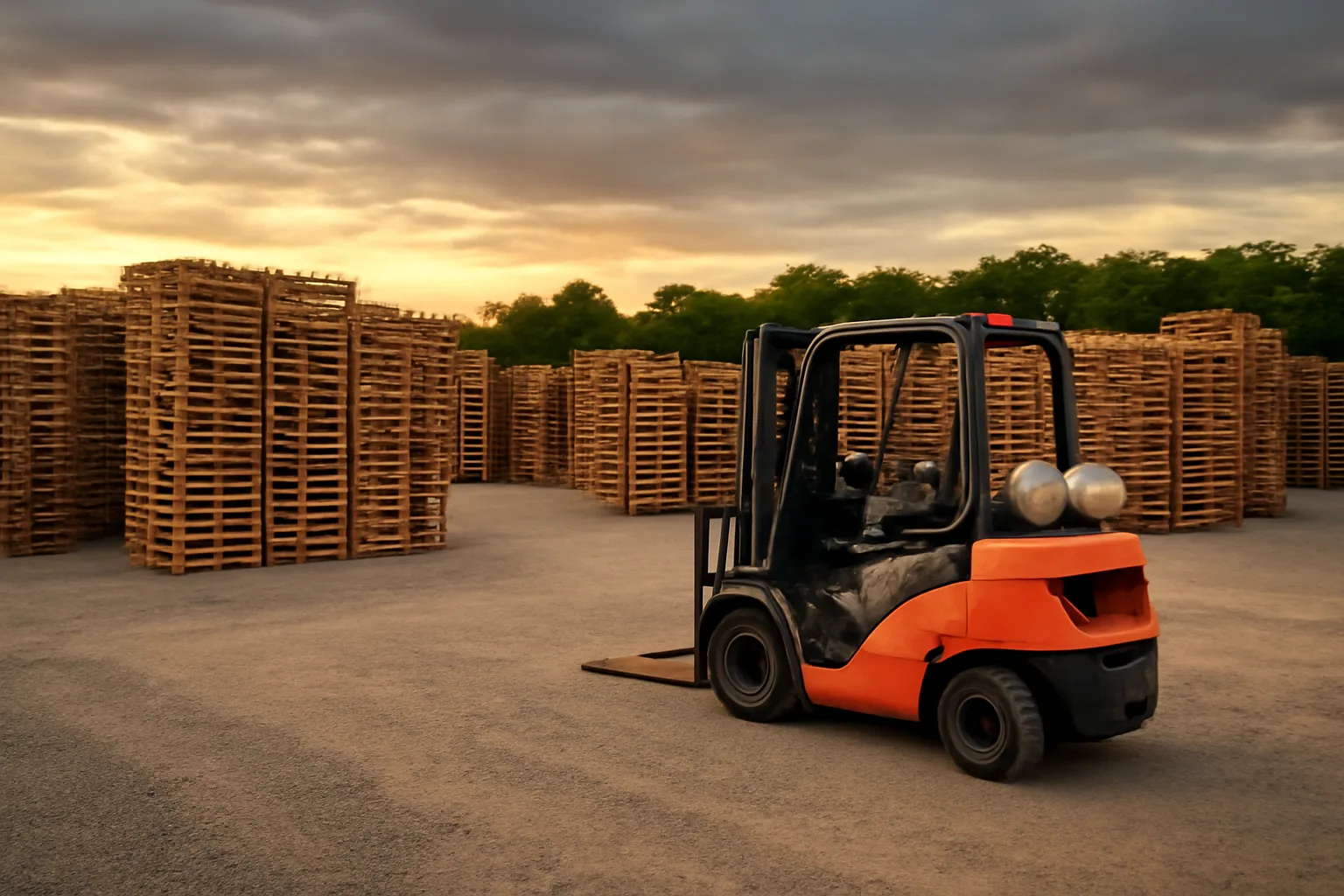
A pallet yard buys, repairs, and resells wooden pallets. Some yards also manufacture new pallets, run a heat treatment operation for export customers, or both. The business is simple on paper. You source used pallets cheaply, sort and repair them, and sell them to warehouses, manufacturers, or brokers who need them.
Arkansas is genuinely decent territory for this. The state sits at the crossroads of several major freight corridors, has a large agricultural and manufacturing base that generates pallet volume, and timber costs for new lumber are lower than in many coastal states. Little Rock, Fort Smith, Fayetteville, and Jonesboro all have industrial activity that creates pallet churn.
The catch is that pallet yards are physically demanding businesses. You need land, a forklift, covered or open storage, and reliable repair labor before you turn a dollar. Do not underestimate the land and equipment side when you're budgeting.
Do you need a license for a pallet yard in Arkansas?
Arkansas does not have a statewide license specifically called a "pallet yard license." That surprises people who ask, and it pays to be precise about what you do and don't need.
Here's the actual paper path:
Business entity registration. If you're operating as anything other than a sole proprietor using your legal name, you register with the Arkansas Secretary of State. An LLC filing costs $45 online as of the time of writing, so confirm current fees at the SOS website [1]. A corporation is $50. Sole proprietors doing business under a trade name file a Doing Business As (DBA) in the county where they operate.
Federal EIN. You get this from the IRS for free. It takes about five minutes online and you get the number immediately [2].
Local business license or permit. Many Arkansas cities and counties require a general business license or occupational tax permit. Little Rock, for example, has a business license requirement. Check with your specific county clerk or city hall. This is the permit layer most people miss.
Zoning and land use. A pallet yard is typically an outdoor storage or light industrial use. Before you sign a lease or buy land, confirm the parcel is zoned for that activity. Arkansas zoning authority sits at the local level. There's no statewide zoning agency.
If you do export heat treatment: APHIS accreditation. This is the one with real federal teeth. If you want to stamp pallets with the ISPM-15 mark so your customers can export them internationally, you must become an accredited heat treatment provider through USDA APHIS. That accreditation involves an application, an agency inspection of your kiln or heat treatment equipment, and ongoing compliance. APHIS describes the process on their Wood Packaging Material program page [3].
If you're only buying and reselling pallets domestically without heat treating them for export, you do not need APHIS accreditation. Most small yards start domestic-only and add accreditation later if demand warrants it.
For a deeper look at the license question specifically, see our guide on pallet yard license in Arkansas.
How much does starting a pallet yard in Arkansas cost?
Nobody has a clean industry study on this. The range is wide because the equipment decision is the biggest swing factor.
Here's a realistic breakdown by category:
| Cost item | Low estimate | High estimate | Notes |
|---|---|---|---|
| Business registration (LLC) | $45 | $200 | SOS filing plus any county DBA [1] |
| Local business license | $0 | $500 | Varies by city/county |
| Land lease (first month + deposit) | $1,500 | $8,000 | Depends heavily on location |
| Forklift (used) | $5,000 | $20,000 | A used propane or electric sit-down is the minimum tool |
| Pallet repair tools (nail guns, saws, hand tools) | $500 | $3,000 | Buy used where you can |
| Initial pallet inventory | $500 | $5,000 | Some yards start by accepting pallets for free from retailers |
| Heat treatment kiln (if pursuing ISPM-15) | $15,000 | $80,000+ | A small chamber kiln vs. a large continuous system [4] |
| APHIS accreditation application | $0 | $0 | The federal application itself has no fee [3] |
| Insurance (general liability, first year) | $800 | $3,500 | See below on insurance |
| Working capital buffer | $2,000 | $10,000 | Labor, fuel, repairs before revenue stabilizes |
For a domestic-only yard with no heat treatment, you can realistically open for $8,000 to $20,000 if you buy equipment used and start with a leased lot. Add a heat treatment kiln and the floor jumps to $30,000 to $100,000 depending on capacity.
Arkansas has no state-specific tax or fee on pallet businesses beyond the standard sales tax framework. The state sales tax rate is 6.5%, and local taxes can push the combined rate higher, but pallet resale tax treatment depends on whether your customers are manufacturers buying for resale, which may qualify for exemptions. The Arkansas Department of Finance and Administration administers sales tax [5]. Confirm your specific situation with a local accountant.
HeatTreatPath offers a Grade A/B pallet classification and ISPM-15 heat treatment documentation kit for $149 one-time at /start, which some yards use to standardize their grading paperwork from day one.
How long does it take to open a pallet yard in Arkansas?
The paperwork itself is fast. An Arkansas LLC registration online processes in one to three business days [1]. An EIN from the IRS is instant online [2]. A local business license varies by city but is typically same-day to two weeks.
The slow parts are everything else.
Finding land. This is usually the longest step. Industrial lots and rural acreage that are zoned correctly and priced reasonably take weeks to months to secure, especially in markets like Fayetteville or Little Rock where light industrial space is competitive.
APHIS accreditation (if applicable). APHIS says to allow time for a site inspection after you submit your application. Processing times vary. The Wood Packaging Material heat treatment program page at APHIS does not publish a guaranteed window [3]. Plan for four to twelve weeks from application to approval as a working estimate, and confirm current timing with the APHIS regional office covering Arkansas.
Equipment delivery and setup. A used forklift can arrive in a week. A new or custom kiln has lead times that can run eight to sixteen weeks depending on the manufacturer.
Realistic total timeline for a domestic-only pallet yard: six to ten weeks from decision to first sale if land is found quickly. For a full heat treatment operation, four to six months is more realistic.
What business structure should you use for an Arkansas pallet yard?
Most small pallet yards start as an LLC. In Arkansas, an LLC gives you liability protection that a sole proprietorship doesn't, and the state's $45 filing fee is low enough that there's no reason to skip it.
A single-member LLC in Arkansas is taxed as a disregarded entity by default, meaning your pallet income flows to your personal return. That's simple and fine for a startup. If you have a partner, you're a multi-member LLC by default, taxed as a partnership.
You can elect S-corp status later once revenue justifies the additional payroll complexity. Don't bother with that on day one.
Arkansas LLCs pay a franchise tax annually. As of 2024, the minimum franchise tax for an LLC is $150 per year [6]. File that with the Secretary of State by May 1 each year.
Get a registered agent if you don't have a permanent business address. Arkansas requires one [1].
What insurance does an Arkansas pallet yard actually need?
General liability insurance is not required by Arkansas state law for a pallet yard, but any landlord with a commercial lease will require it, and any large customer will require a certificate of insurance before they do business with you. A million-dollar per-occurrence general liability policy for a small pallet yard typically runs $800 to $2,500 per year, though that range is rough and your actual quote depends on payroll, revenue, and claims history.
If you have employees, Arkansas law requires workers' compensation insurance for most employers with three or more employees [7]. That threshold is lower than many states. Check current requirements with the Arkansas Workers' Compensation Commission.
If you finance a forklift or kiln, the lender will require commercial property or equipment insurance on the collateral.
Commercial auto coverage is required by law if your trucks operate on public roads in Arkansas, just as in every other state.
What is ISPM-15 heat treatment, and do Arkansas pallet yards need it?
ISPM-15 is the international standard for wood packaging material used in global trade. Pallets exported from the United States must be heat treated to a core temperature of 56 degrees Celsius for a continuous 30 minutes, then stamped with the IPPC mark showing the treatment method and the producer code [3].
USDA APHIS is the agency that accredits U.S. heat treatment providers. The APHIS Wood Packaging Material page states that wood packaging material must be treated and marked in compliance with ISPM-15 before it can move in international trade, and that producers must use approved facilities and recordkeeping to apply the mark [3].
For Arkansas yards that serve local manufacturers who export goods, ISPM-15 capability is a real competitive advantage. For yards serving local retail distribution centers and domestic warehouses, it's optional.
The equipment options are a batch kiln (you load pallets, heat them, hold temperature, then unload) or a continuous heat treatment system (pallets move through on a conveyor). Batch kilns are cheaper to start and make sense at lower volumes. Continuous systems cost more but can process thousands of pallets per day.
Maintaining ISPM-15 compliance means keeping temperature data logs for every treatment run. That paperwork requirement is real and ongoing. Some small yards use purpose-built software. Others use simple spreadsheets.
For a comparison with how neighboring states handle this, the how to start a pallet yard in Alabama guide covers a similar paper path.
How do you find pallet inventory to buy in Arkansas?
Your sourcing network is your business. Most yards build it from a few channels.
Retailers and big-box stores. Walmart, Home Depot, grocery distribution centers, and similar retailers generate enormous pallet volume. Many sell their used pallets for $1 to $4 each or give them away to avoid disposal costs. The key is showing up consistently and having the truck capacity to remove them on the store's schedule.
Manufacturing plants. Arkansas has food processing, poultry processing, paper/pulp, and metal fabrication plants. These generate pallets as a byproduct of receiving raw materials. Cold-call purchasing managers.
Pallet brokers. Larger brokers sometimes have more volume than their capacity can handle and will sell overflow. Getting on a broker's preferred vendor list takes time but can smooth out your inventory cycles.
Pallet reclamation programs. Some national retailers (Walmart is the most famous example) run formal pallet buyback programs. Qualifying for those is a longer-term goal.
Grading matters here. Pallets sort into Grade A (near-new, few repairs), Grade B (usable, some repairs needed), Grade C (heavily damaged, scrap or repair-heavy), and scrap. Knowing how to grade quickly and consistently is what lets you price accurately and build customer trust.
What equipment does a pallet yard need to get started in Arkansas?
The minimum viable equipment list for a small yard:
Forklift. A standard 5,000-pound propane sit-down forklift is the workhorse. Buy used. A decent used Clark, Toyota, or Crown in that class runs $5,000 to $15,000. Budget for maintenance.
Pallet repair tools. You need a pneumatic nailing system (a pallet nailer or a coil-fed framing nailer), a circular saw for cutting boards, and basic hand tools. A proper pallet repair stand speeds up labor significantly.
Truck or trailer. You need to pick up and deliver pallets. A flatbed trailer pulled by a pickup or a box truck both work. This is often the item people underestimate at startup.
Scale (optional but useful). Some customers buy by weight. A drive-on scale costs $2,000 to $8,000 but can pay back quickly if you're doing volume.
Heat treatment kiln (if applicable). Discussed above. Size your kiln to your realistic first-year heat treatment volume, not your optimistic five-year projection.
Arkansas has a reasonable secondary equipment market. Check local auction sites, equipment dealers in Little Rock and Fort Smith, and national platforms like IronPlanet for used forklifts and kilns.
What taxes and ongoing compliance does an Arkansas pallet yard face?
The annual obligations are not complicated, but they're real.
Arkansas franchise tax. Due May 1 each year. Minimum $150 for LLCs [6].
State and local sales tax. Arkansas sales tax is 6.5% at the state level [5]. Local rates vary. Whether you collect sales tax on pallet sales depends on your customers and use cases. Many pallet sales to manufacturers may qualify as sales for resale (exempt). Get this sorted with an Arkansas CPA early, not after your first audit notice.
Payroll taxes. If you have employees, you'll handle state income tax withholding, unemployment insurance through the Arkansas Division of Workforce Services [8], and federal payroll taxes.
Workers' comp insurance. Required if you have three or more employees [7]. This is an ongoing premium, not a one-time cost.
Annual Secretary of State report. The annual franchise tax filing with the SOS doubles as your annual report. Don't miss the May 1 deadline or you risk losing your good standing.
If you add a heat treatment operation, keep your APHIS treatment records indefinitely. APHIS can ask to audit them.
Where can you find more state-specific pallet yard startup guidance?
If you're comparing Arkansas to neighboring states or considering operating in multiple states, a few of these guides cover the same paper path in detail:
- How to start a pallet yard in Alabama
- Pallet yard license in Alabama
- How to start a pallet yard in Arizona
- How to start a pallet yard in Colorado
For ISPM-15 documentation and pallet grading kits, HeatTreatPath's Grade A/B + HT Kit ($149 one-time) covers the treatment log templates and grading standards most small yards need from day one. You can find it at /start.
For legal entity questions specific to your situation, the Arkansas Small Business and Technology Development Center (ASBTDC) provides free advising and is the right first call before spending money on an attorney [9].
Frequently asked questions
Do you need a license for a pallet yard in Arkansas?
There's no single statewide pallet yard license in Arkansas. You register your business entity with the Secretary of State, get a federal EIN, and comply with any local city or county business license requirements where you operate. If you heat treat pallets for export under the ISPM-15 standard, you also need USDA APHIS accreditation as a heat treatment provider. That's the real paper path.
How much does it cost to start a pallet yard in Arkansas?
A domestic-only pallet yard (no heat treatment) can open for roughly $8,000 to $20,000 if you buy equipment used and lease land. Add ISPM-15 heat treatment capability and the starting cost jumps to $30,000 to $100,000 or more depending on kiln size and capacity. The biggest variables are land cost, forklift condition, and whether you add a kiln at startup or later.
How long does it take to open a pallet yard in Arkansas?
The state paperwork (LLC filing, EIN) takes one to three business days. Finding and securing land is usually the longest step, often four to eight weeks. For a domestic-only yard, six to ten weeks from decision to first sale is realistic. If you're adding APHIS-accredited heat treatment, allow four to six months total to account for equipment delivery and the inspection process.
Does an Arkansas pallet yard need ISPM-15 heat treatment certification?
Only if you want to treat pallets for international export. Pallets crossing international borders must carry the IPPC mark showing ISPM-15 compliance. To apply that mark legally, your facility must be accredited by USDA APHIS. Yards selling pallets only for domestic use don't need it, but adding heat treatment capability opens a higher-margin customer segment.
What is the Arkansas LLC filing fee for a pallet business?
Arkansas charges $45 to file an LLC online through the Secretary of State as of the time of writing. Confirm the current fee at the Arkansas SOS website before filing, as fees can change. A corporation costs $50. Sole proprietors using a trade name file a DBA at the county level, and those fees vary by county.
Does Arkansas require workers' compensation insurance for pallet yard employees?
Yes. Arkansas law requires most employers with three or more employees to carry workers' compensation insurance, administered through the Arkansas Workers' Compensation Commission. That threshold is lower than many states, so even a small crew triggers the requirement. Get a certificate of insurance from your carrier before your third employee starts.
How do I get USDA APHIS heat treatment accreditation in Arkansas?
Apply through the USDA APHIS Wood Packaging Material program. There's no application fee. After you submit, APHIS schedules a site inspection to verify your equipment and procedures. Processing time varies. Plan for four to twelve weeks. Arkansas falls under APHIS's Southern region. Contact that regional office for current timelines before you schedule equipment installation.
What zoning do I need for a pallet yard in Arkansas?
Pallet yards are typically classified as outdoor storage or light industrial uses. Zoning authority in Arkansas is local, not statewide, so you confirm the classification with your specific county or city planning office. Always verify zoning before signing a lease or purchasing land. Rezoning applications can add months to your timeline if the parcel isn't already classified correctly.
Do I charge Arkansas sales tax when I sell pallets?
It depends on your customer's use. Sales to manufacturers who buy pallets as part of their production process may qualify for a sales-for-resale exemption under Arkansas tax rules. Sales to end users who won't resell the pallets are generally taxable. Arkansas's base sales tax rate is 6.5%, with local additions. Get specific guidance from an Arkansas CPA before you set your invoicing up.
What is the annual franchise tax for an Arkansas pallet yard LLC?
Arkansas LLCs pay a minimum franchise tax of $150 per year, due May 1. This filing with the Secretary of State also doubles as your annual report. Missing the deadline can result in penalties and eventually loss of good standing. The fee scales up for larger entities but $150 is the floor for a small LLC.
Can I start a pallet yard in Arkansas without a forklift?
Technically yes, at micro-scale, using hand jacks and ramps. Practically, no. You can't sort, stack, or load volume without a forklift, and customers expecting truckload quantities won't tolerate manual handling delays. A used 5,000-pound propane forklift is the minimum realistic tool. Buy used to keep the entry cost down, and budget for monthly maintenance.
Where do I register a pallet yard business in Arkansas?
File your LLC or corporation with the Arkansas Secretary of State online at sos.arkansas.gov. Get your federal EIN free at irs.gov. Then check with your city hall or county clerk for any local business license or occupational permit. That three-step sequence covers the core registration requirements for most pallet yards in the state.
What is the difference between Grade A and Grade B pallets?
Grade A pallets are essentially like-new: minimal cosmetic wear, no missing or broken boards, full structural integrity. Grade B pallets show visible wear, may have one or two repaired boards, but are still structurally sound for normal loads. Grade C pallets need significant repair or are sold as scrap wood. Consistent grading is what lets you price accurately and avoid customer disputes.
Sources
- Arkansas Secretary of State, Business and Commercial Services: LLC Formation: Arkansas LLC online filing fee is $45; Arkansas corporation filing fee is $50
- IRS, Apply for an Employer Identification Number (EIN) Online: Federal EIN is free and issued immediately when applied for online through the IRS
- USDA Forest Products Laboratory, Report FPL-GTR-238: Heat Treatment of Wood Packaging Material: ISPM-15 requires wood core temperature of 56 degrees Celsius for a continuous 30 minutes; describes batch and continuous kiln options for heat treatment
- Arkansas Department of Finance and Administration, Sales and Use Tax: Arkansas state sales tax rate is 6.5%; local rates may apply in addition
- Arkansas Secretary of State, Annual Franchise Tax Information: Arkansas LLC minimum annual franchise tax is $150, due May 1
- Arkansas Workers' Compensation Commission: Arkansas law requires workers' compensation insurance for most employers with three or more employees
- Arkansas Division of Workforce Services: Arkansas employers with employees must register for and pay state unemployment insurance through the Division of Workforce Services
- Arkansas Small Business and Technology Development Center (ASBTDC): ASBTDC provides free business advising to Arkansas small business owners, including help with entity selection and startup planning